17 Must Try Living Room Cabinets Ideas You Will Love To See
- 1. Floating Wall Cabinets for Spatial Expansion
- 2. Full Height Built In Cabinets for Architectural Integration
- 3. Seamless TV Wall Cabinets with Concealed Wiring
- 4. Glass Display Cabinets for Controlled Visual Storytelling
- 5. Natural Wood Cabinets for Emotional Warmth
- 6. Handleless Minimal Cabinets for Visual Purity
- 7. Mixed Open and Closed Storage for Functional Balance
- 8. Corner Cabinets for Hidden Space Optimization
- 9. LED Integrated Cabinets for Mood Architecture
- 10. High Gloss Cabinets for Reflective Expansion
- 11. Concealed Cabinet Systems for Ultra Minimal Design
- 12. Multi Functional Cabinet Units with Work Integration
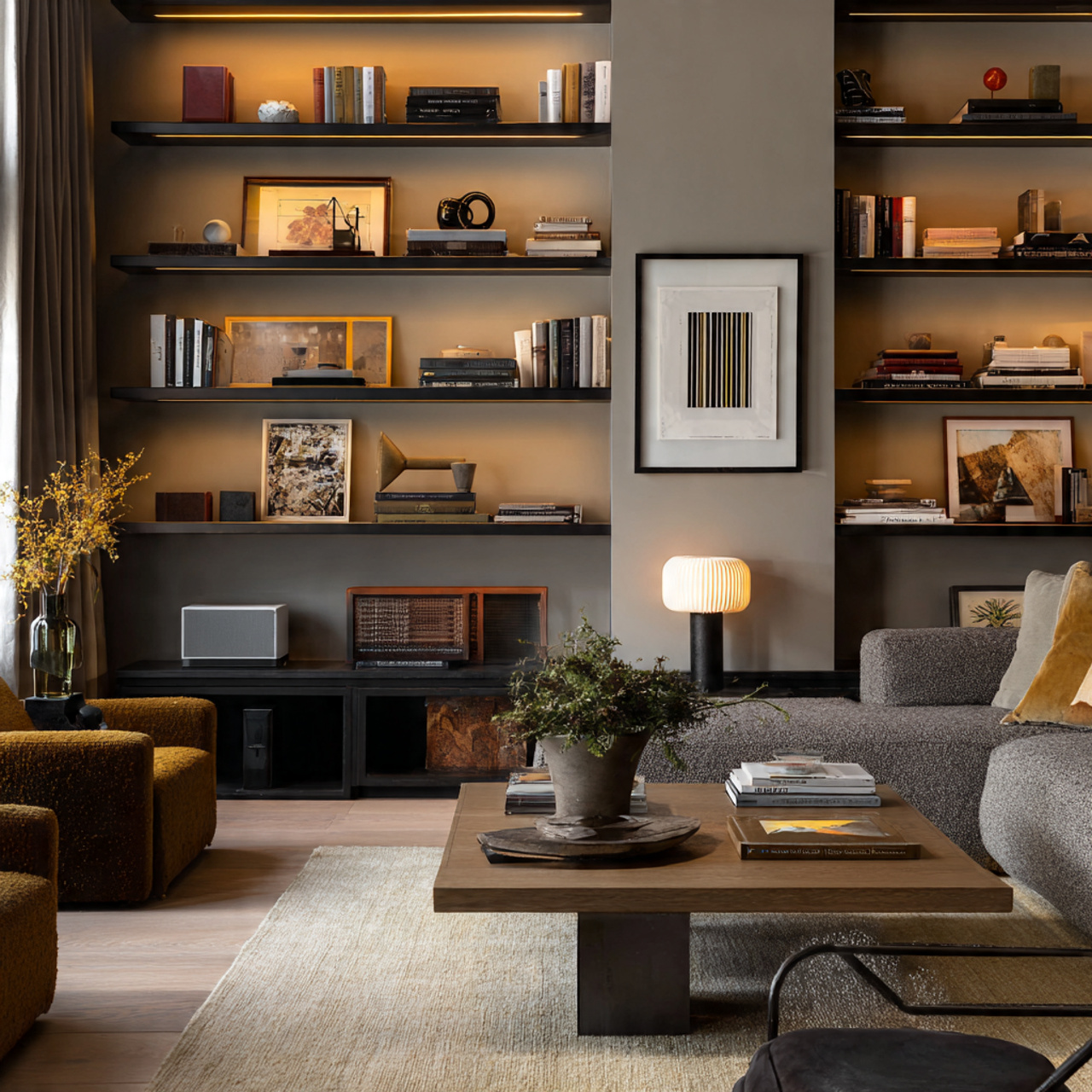
- 13. Floating Shelves with Layered Styling Depth
- 14. Marble Finish Cabinets for Luxury Perception
- 15. Sliding Door Cabinets for Space Efficiency
- 16. Industrial Style Cabinets for Structural Contrast
- 17. Full Wall Entertainment Units as Design Anchors
- Final Professional Guidance
As a professional interior designer, I want you to look at living room cabinets differently than most people do. They are not just storage units placed against a wall. In well-planned interiors, cabinetry behaves like architecture. It controls proportions, hides chaos, frames focal points, and quietly defines how the entire living room feels in daily life.
A good cabinet design does three things at once: it organizes clutter, enhances visual balance, and supports the lifestyle of the people using the space. Below are 17 living room cabinet ideas explained in a practical, design-focused way so you can actually apply them in real homes, not just admire them.
1. Floating Wall Cabinets for Spatial Expansion

Floating cabinets are one of the simplest ways to visually enlarge a living room. By lifting storage off the floor, you immediately reduce visual weight at the lower level of the room, which makes the space feel wider and more breathable.
From a design perspective, this works because the eye reads more uninterrupted floor area as bigger space. I usually recommend keeping floating units aligned with the TV wall or sofa wall to create a continuous horizontal line, which improves flow. For finishes, matte wood or soft neutral laminates work best because they avoid unnecessary reflection and maintain calmness in the room.
2. Full Height Built In Cabinets for Architectural Integration

When I design living rooms for clients who need serious storage, I always consider full height built in cabinetry. These systems extend from floor to ceiling and essentially become part of the architecture rather than furniture.
The key to doing this correctly is proportion control. If the entire wall is closed storage, the room can feel heavy. To avoid this, I usually break the structure into three zones: closed base storage, mid level display or media zone, and upper concealed storage. This creates rhythm and prevents visual monotony.
Lighting also plays a major role here. Even a simple LED strip in vertical divisions can transform a heavy wall into a premium architectural feature.
3. Seamless TV Wall Cabinets with Concealed Wiring

The TV wall is often the focal point of the living room, so it should never look like a random screen mounted on a plain wall. A properly designed TV cabinet integrates the screen, storage, and wiring into one unified composition.
Professionally, I design these walls as media compositions. The TV becomes one element, not the center of chaos. Surrounding cabinetry should hide routers, cables, remotes, and devices completely. I often recommend using push to open drawers and cable management channels behind panels to maintain a clean surface.
If you want a high end result, add indirect backlighting behind the TV panel. It reduces eye strain and adds depth, especially in evening lighting.
4. Glass Display Cabinets for Controlled Visual Storytelling

Glass cabinets are not meant to display everything you own. They are meant to curate a visual story.
As a designer, I treat these cabinets like a gallery wall in 3D form. That means every object inside should be intentional. Books, ceramics, travel items, or art pieces should be spaced with negative space between them.
Interior lighting is crucial here. Warm LED lighting enhances textures and creates a soft glow that immediately elevates the room. Without lighting, glass cabinets often look flat and unfinished.
5. Natural Wood Cabinets for Emotional Warmth

Wood is one of the most psychologically powerful materials in interior design. It introduces warmth, reduces visual tension, and makes a space feel lived in rather than staged.
When selecting wood tones, always consider natural light. In bright rooms, deeper tones like walnut add sophistication. In low light spaces, lighter woods like oak prevent the room from feeling heavy.
A professional tip is to always match or complement wood tones with flooring or furniture legs to maintain visual continuity.
6. Handleless Minimal Cabinets for Visual Purity

Handleless cabinetry is essential in modern interiors because it removes visual interruption. Every handle is technically a break in design continuity, so removing them creates a cleaner architectural surface.
There are two professional systems used here: push to open mechanisms and J pull grooves. Push systems create ultra clean facades, while J pull offers slightly more durability for heavy use zones.
This style works best in minimalist, Scandinavian, and modern luxury interiors where simplicity is the design language.
7. Mixed Open and Closed Storage for Functional Balance

A mistake I often see is either fully open shelving or fully closed storage. Both extremes create problems.
Open shelves provide styling opportunity but quickly become visually messy. Closed cabinets hide everything but can feel too rigid.
The correct professional approach is balance. I usually design 70 percent closed storage and 30 percent open display. This ensures daily clutter stays hidden while curated decor adds personality.
8. Corner Cabinets for Hidden Space Optimization

Corners are often ignored in living room layouts, but they are valuable storage zones if designed correctly.
Corner cabinetry should never feel forced. It should follow the natural geometry of the room. Custom angled shelves or rotating storage systems can convert dead corners into highly functional areas.
In smaller homes, this alone can add significant storage without changing the main layout.
9. LED Integrated Cabinets for Mood Architecture

Lighting is not decoration, it is architecture.
Integrated LED lighting inside cabinets changes how the entire room is perceived. It adds depth, highlights materials, and creates mood transitions between day and night.
I always recommend using warm white lighting 2700K to 3000K for living rooms because it supports relaxation. Cool white lighting should be avoided unless the space is very modern and minimal.
10. High Gloss Cabinets for Reflective Expansion

High gloss finishes are not just aesthetic, they are spatial tools. They reflect light and surroundings, which can visually expand smaller living rooms.
However, they must be used carefully. Overuse creates a cold showroom like feeling. The professional approach is to combine gloss with matte textures such as matte walls or wood floors to maintain balance.
11. Concealed Cabinet Systems for Ultra Minimal Design

Hidden cabinetry is one of the most advanced interior techniques. Here, storage disappears into wall panels, creating a seamless surface.
This is not just design, it is perception control. The room feels larger and calmer because the eye does not register storage clutter.
This system requires precise planning during the construction phase, so it must be designed early, not added later.
12. Multi Functional Cabinet Units with Work Integration

Modern living rooms often double as workspaces. Instead of adding separate furniture, I integrate a compact study zone within cabinetry.
The key is separation without isolation. Visually, the work area should feel like part of the living room but functionally remain organized and focused.
Proper cable routing, hidden drawers, and ergonomic height placement are essential for usability.
13. Floating Shelves with Layered Styling Depth

Floating shelves should never be random. They require composition thinking.
I usually design them in layers: large objects at the bottom, medium objects in the middle, and light decorative items on top. This creates visual stability.
Adding soft under shelf lighting enhances depth and prevents the shelves from looking flat against the wall.
14. Marble Finish Cabinets for Luxury Perception

Marble finishes introduce instant luxury, but they must be used with restraint. In cabinetry, marble is best applied as accents rather than full coverage unless the space is large and well lit.
The goal is sophistication, not overload. Pairing marble with black, gold, or warm wood creates a high end curated aesthetic.
15. Sliding Door Cabinets for Space Efficiency

Sliding systems are essential in compact homes because they eliminate door swing clearance.
From a design perspective, they also create smoother surfaces. However, track quality is critical. Poor sliding systems break the luxury feel immediately.
I always recommend soft close sliding hardware for premium usability.
16. Industrial Style Cabinets for Structural Contrast

Industrial cabinetry combines raw materials like metal frames with wood or concrete textures.
This style works best when the rest of the room is relatively simple. It introduces controlled contrast and structure.
The key is not to overdo it. Industrial design should feel intentional, not chaotic.
17. Full Wall Entertainment Units as Design Anchors

A full wall entertainment unit is the most complete living room cabinet solution. It combines storage, display, lighting, and media into one unified system.
Professionally, I treat this as the main architectural feature wall. Everything else in the living room supports this structure visually.
The success of this design depends on proportion, symmetry, and material harmony. Every section must have a purpose, otherwise the wall becomes visually heavy.
Final Professional Guidance
If there is one thing I want you to understand as a designer, it is this: cabinetry is not about filling walls, it is about shaping experience.
A well designed living room cabinet system improves daily life in three ways. It removes visual stress by hiding clutter, it improves functionality by organizing storage logically, and it enhances emotional comfort by creating visual order.
Before choosing any design, always ask three questions. What do I need to store. How clean do I want the space to feel. How should the room make me feel when I enter it.
When you design with those questions in mind, cabinets stop being furniture and start becoming architecture that quietly improves your lifestyle every single day.